
Unknown's avatar

 2025 AI & Data Leadership Executive Survey

The 2025 AI & Data Leadership Executive Survey, is an industry benchmark that surveys Fortune 1000 and global business leaders. This year, 97.6% of survey respondents identified themselves as C-suite executives or equivalents within their organization.

What is the state of Data and AI according to these leaders? There are 6 main takeaways

1- Corporate investments in AI and data are growing. The rapid emergence of AI/Generative AI, is fueling increased organizational investment in AI & data, with data & AI seen as a top organizational priority by a growing percentage of organizations

  • 98% – Companies are increasing investment in data and AI
  • 91% – Investments in Data & AI are a Top Organizational Priority
  • 94% – Interest in AI is Leading to a Greater Focus on Data

2- Organizations are reporting business value from their AI investments. AI initiatives are at an early stage for most companies, but progress is accelerating, with more initiatives moving into production as firms are beginning to deliver measurable business value.

  • Data and AI Investments:
    • 18% – High Degree of Measurable Business Value
    • 28% – Significant and Rapidly Growing Level of Business Value
    • 32% – Modest but Increasing Amount of Incremental Business Value
  • Generative AI Implementation Efforts
    • 24% – Implemented in Production At Scale
    • 47% – Early Stage: Implemented in Limited Production
    • 29% – Early Stage: Experimentation, Testing, Planning & Design
  • Primary Business Value generated by AI/Gen AI
    • 58% – Exponential productivity gains and Efficiency
    • 16% – Liberate Knowledge Workers from Mundane Tasks
    • 17% – Improve Customer Service and Experience
    • 10% – Deliver Business Growth

3- Transformation due to AI will be gradual for most organizations. A minority of organizations claim to be data/AI driven or having established a data/AI business culture., and most organizations continue to struggle with adoption and transformation, with cultural challenges noted as the greatest obstacle to progress.

  • 92% – The primary barrier to establishing data- and AI-driven cultures is people and organization change

4- Organizations are focusing on responsible AI, safeguards, and guardrails. Responsible AI is an increasing priority for most organizations, as they focus on establishing safeguards and guardrails to ensure responsible AI utilization. Threats of misinformation and disinformation, as well as ethical bias, are ongoing concerns, as is the recognition that more AI talent is needed, and corporate boards require greater education on AI.

  • Investment in Responsible AI.
    • 74% – Investment in Responsible AI is a Top Corporate Priority
    • 98% – Responsible AI Safeguards and Guardrails for Governing AI Must Be In Place
    • 78% – Responsible AI Safeguards and Guardrails for Governing AI Are In Place Today
    • 57% – Talent is in Place to Ensure Responsibly AI Implementation
  • Primary business threat by AI
    • 53% – Spread of Misinformation or Disinformation
    • 20% – Ethical Bias
    • 5% – Job Loss and Job Displacement

5- Organizations are hiring chief AI officers as AI and data leadership roles evolve. Data & AI leadership is in high demand, with Chief Data Officers (CDO/CDAO) and Chief Artificial Intelligence Officers (CAIO) being appointed. Additionally, more data & AI executives are focusing on delivering business value through growth and innovation, and reporting to business leaders.

  • Data & AI Leadership Roles and Responsibilities
    • 84% – Chief Data Officer (CDO/CDAO) Has Been Appointed
    • 33% – Chief AI Officer (CAIO) Has Been Appointed
  • Primary Focus of Data & AI Leadership (CDO/CDAO/CAIO)
    • 80% – Offense -> Growth | Innovation | Transformation
    • 20% – Defense -> Risk Management | Regulatory | Compliance
  • Data & AI Leadership Reporting Structures/Reporting to
    • 36% – Business Leadership | CEO | President | COO
    • 47% – Technology Leadership | CIO | CTO | Head of Tech & Ops
    • 11% – Transformation Leadership | Chief Digital Officer

6- AI is likely to be the most transformational technology in a generation. Organizations strongly believe in the transformational impact of AI, foreseeing significant opportunity for productivity and efficiency gains, with the potential benefits clearly outweighing the potential risks.

  • Forecasting an AI Future
    • 89% – AI is Likely to be the Most Transformational Technology in a Generation
    • 61% – Generative AI Will be the Most Transformative Form of AI
    • 97% – Overall Impact of AI will be Beneficial

In short, the future is bright for organizations investing in AI with the right Data and AI skills, talent, and leadership in place, and focus on Responsible AI, safeguards and guardrails.
Unknown's avatar

The Evolving Landscape of Data and AI Maturity: Insights from the 2024 DAICAMA Survey

Data and AI Maturity are increasing overall, but it is getting harder to reach the highest levels of Maturity. In a recent survey (DAICAMA) of almost 1,200 companies worldwide – representing nine major industry clusters -, BCG found that while 95% of companies are striving to leverage AI for business value, the proportion of companies qualifying as the most mature in Data and AI declined from 13% in their 2021 survey to 8% today. As data and AI capabilities become more sophisticated, it becomes more difficult to develop and maintain high levels of Maturity. This is partially due to how Generative AI has changed the landscape and introduced new opportunities and challenges. This survey also had other top level findings:

  • More companies are recognizing the interdependence of Data and AI capabilities to unlock the full value of data, and are focused on increasing both Data and AI Maturity
  • The main difference between organizations with high vs low Data and AI Maturity is on the levels of maturity for 1/Ideation and prioritization, 2/Attracting and retaining top AI talent, 3/Establishing business-driven data governance, 4/Creating data ecosystems, and 5/Fostering a data-driven culture.
  • Companies that are not setting realistic expectations for Data and AI Maturity end up with lower enthusiasm for AI transformation
  • Companies with high Data and AI Maturity:
    • Have 4 times more use cases scaled and adopted across their business than those with low maturity.
    • For each use case they implement, the average financial impact is five times greater.

A Closer Look at Maturity Levels

The DAICAMA survey showed that traditional data-rich sectors like technology, finance, consumer and healthcare continue to lead, while industries such as automotive are making significant strides. However, the public sector lags behind, hindered by a lack of pressure to adopt digital solutions and a challenge in attracting the necessary talent.

Geographically, the U.S. maintains its status as the leader in data maturity, with Singapore as a close second. India, in particular, has seen a 23% increase, thanks in part to government and private-sector investments in digital infrastructure.

Setting Realistic Ambitions

While many companies aim to scale their AI initiatives within three years, historical data indicates that most will likely fall short of their ambitions. The average company has historically moved up just one maturity level every ten years. This slow pace of growth has surprised many executives, and this realization has led them to recalibrate their expectations, with the latest survey showing a trend toward setting more attainable goals.

Enhancing Maturity Across Capabilities

Companies are increasingly recognizing the importance of improving all capabilities that contribute to data and AI maturity. This holistic approach helps them avoid the pitfalls of focusing on isolated improvements. By addressing the interdependencies among capabilities, organizations are better positioned to unlock the full potential of their data assets.

Five Areas Where Leaders Excel

Despite the decline in the proportion of highly mature companies, those that do achieve top-tier status are significantly outpacing their peers in several key areas:

  1. Ideation and Prioritization: Leading firms empower business leaders to innovate, focusing on transformative use cases rather than small, incremental improvements.
  2. Talent Acquisition: These companies invest heavily in attracting and retaining top AI talent, ensuring their teams possess both technical skills and business acumen.
  3. Business-Driven Data Governance: Top players implement data governance structures that address specific business needs, moving beyond mere compliance.
  4. Data Ecosystems: By forming strategic partnerships, leading organizations create robust ecosystems that drive new value and competitive advantage.
  5. Data-Driven Culture: They foster a culture that embraces data, using behavioral science to encourage adoption and track progress.

For organizations navigating the complexity of building their AI maturity, the first step is to assess their current maturity level for each needed capability. By identifying high-impact use cases and developing the necessary capabilities, companies can create a unified approach that accelerates their journey toward data and AI excellence. The road may be challenging, but with strategic planning and execution, the potential rewards are substantial. One Framework that can be used for identifying the needed capabilities, is AWS’ CAF-AI Framework.

Embracing the evolving nature of data and AI is no longer just a competitive advantage—it’s essential for survival in the modern business world.

The full report is here: https://www.bcg.com/publications/2024/leaders-in-data-ai-racing-away-from-pack

Unknown's avatar

AI and Generative AI are taking the world by storm

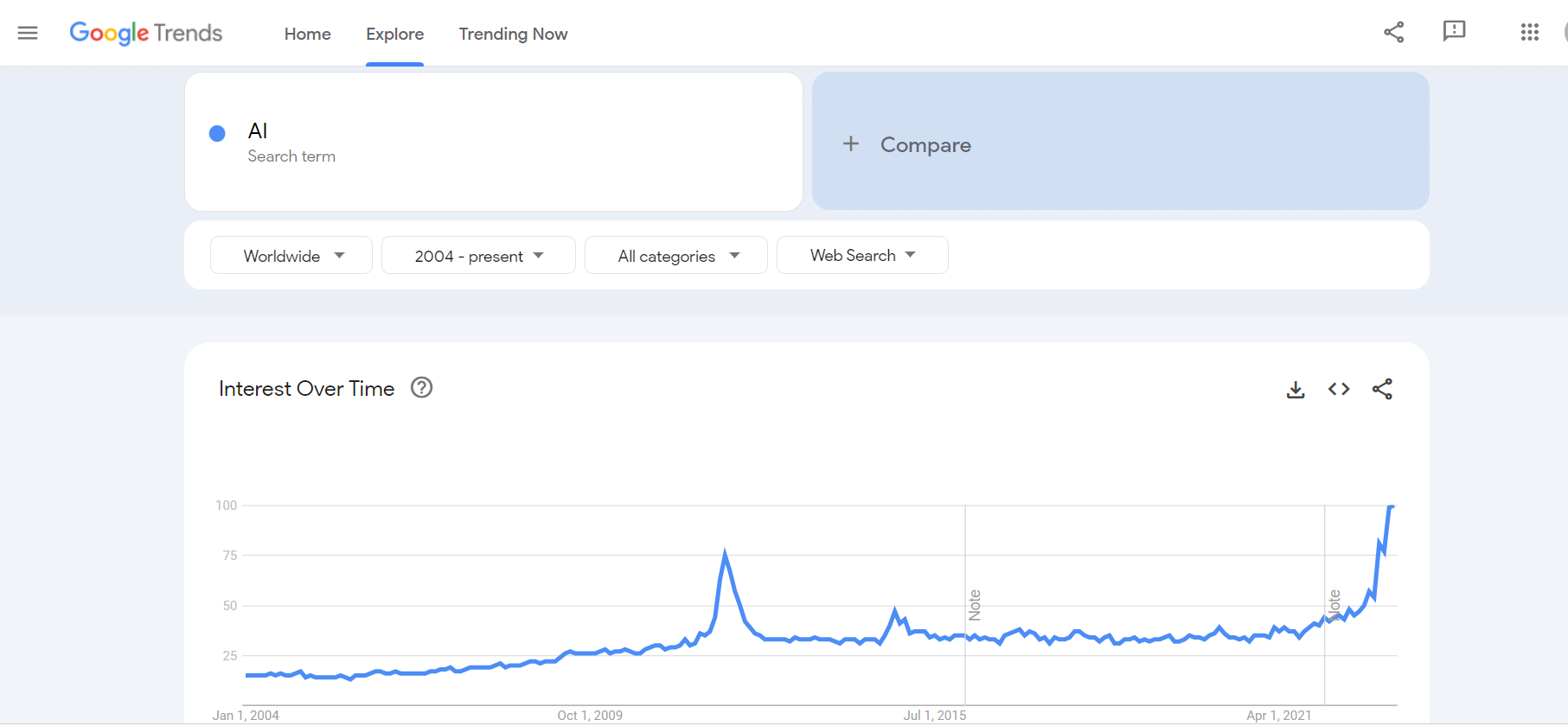
AI is everywhere and the hype around it is like nothing we have ever seen before. Just take a look at what Google trends show us about worldwide web searches for the word AI during the past 19 years. There was a peak in 2011 probably generated by IBM Watson’s winning Jeopardy and Apple’s launch of Siri – 2 extremely significant innovations at the time. But nothing compares to the levels of interest generated over the past few months for AI and Generative AI.

Worldwide Searches for the word AI – 2004-2023

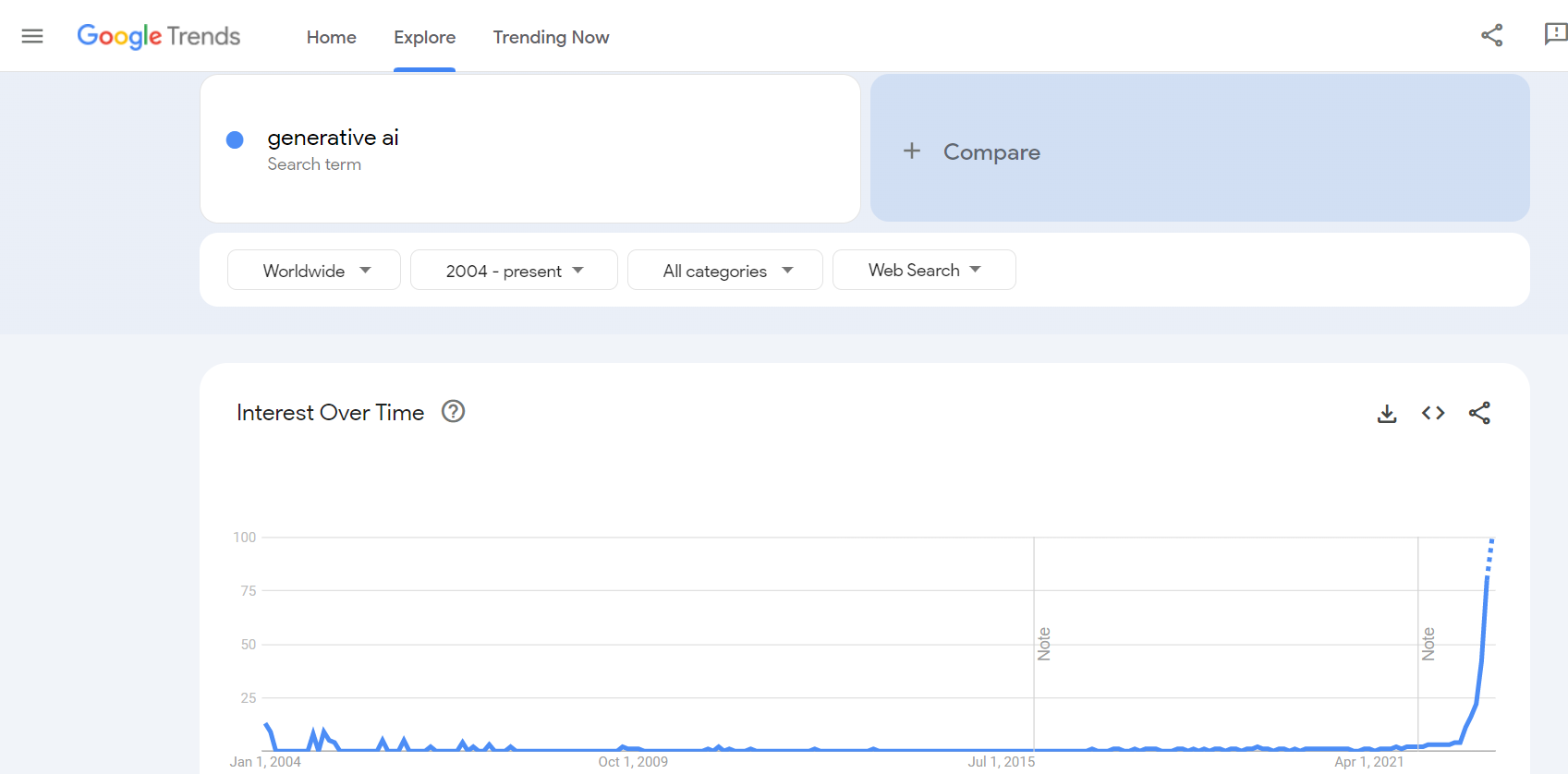
I have worked in the AI field for over a decade, and I have never seen AI technologies evolve with such speed and innovation like we are seeing now through Generative AI. The AI field is being revolutionized, and these new technologies will bring powerful new capabilities that can be turned into value for individuals, businesses, and society. And this is what Google trends show us about worldwide web searches for Generative AI during the past 19 years.

Worldwide Searches for the words Generative AI – 2004-2023

This AI revolution is great for those of us that are passionate about AI’s capabilities to change the world in a positive way – as long as it is deployed with safety in mind. It is also highly relevant for businesses looking to derive incremental and transformational business value. It is safe to say that the world of AI is now moving into a whole new era.