Unknown's avatar

 2025 AI & Data Leadership Executive Survey

The 2025 AI & Data Leadership Executive Survey, is an industry benchmark that surveys Fortune 1000 and global business leaders. This year, 97.6% of survey respondents identified themselves as C-suite executives or equivalents within their organization.

What is the state of Data and AI according to these leaders? There are 6 main takeaways

1- Corporate investments in AI and data are growing. The rapid emergence of AI/Generative AI, is fueling increased organizational investment in AI & data, with data & AI seen as a top organizational priority by a growing percentage of organizations

  • 98% – Companies are increasing investment in data and AI
  • 91% – Investments in Data & AI are a Top Organizational Priority
  • 94% – Interest in AI is Leading to a Greater Focus on Data

2- Organizations are reporting business value from their AI investments. AI initiatives are at an early stage for most companies, but progress is accelerating, with more initiatives moving into production as firms are beginning to deliver measurable business value.

  • Data and AI Investments:
    • 18% – High Degree of Measurable Business Value
    • 28% – Significant and Rapidly Growing Level of Business Value
    • 32% – Modest but Increasing Amount of Incremental Business Value
  • Generative AI Implementation Efforts
    • 24% – Implemented in Production At Scale
    • 47% – Early Stage: Implemented in Limited Production
    • 29% – Early Stage: Experimentation, Testing, Planning & Design
  • Primary Business Value generated by AI/Gen AI
    • 58% – Exponential productivity gains and Efficiency
    • 16% – Liberate Knowledge Workers from Mundane Tasks
    • 17% – Improve Customer Service and Experience
    • 10% – Deliver Business Growth

3- Transformation due to AI will be gradual for most organizations. A minority of organizations claim to be data/AI driven or having established a data/AI business culture., and most organizations continue to struggle with adoption and transformation, with cultural challenges noted as the greatest obstacle to progress.

  • 92% – The primary barrier to establishing data- and AI-driven cultures is people and organization change

4- Organizations are focusing on responsible AI, safeguards, and guardrails. Responsible AI is an increasing priority for most organizations, as they focus on establishing safeguards and guardrails to ensure responsible AI utilization. Threats of misinformation and disinformation, as well as ethical bias, are ongoing concerns, as is the recognition that more AI talent is needed, and corporate boards require greater education on AI.

  • Investment in Responsible AI.
    • 74% – Investment in Responsible AI is a Top Corporate Priority
    • 98% – Responsible AI Safeguards and Guardrails for Governing AI Must Be In Place
    • 78% – Responsible AI Safeguards and Guardrails for Governing AI Are In Place Today
    • 57% – Talent is in Place to Ensure Responsibly AI Implementation
  • Primary business threat by AI
    • 53% – Spread of Misinformation or Disinformation
    • 20% – Ethical Bias
    • 5% – Job Loss and Job Displacement

5- Organizations are hiring chief AI officers as AI and data leadership roles evolve. Data & AI leadership is in high demand, with Chief Data Officers (CDO/CDAO) and Chief Artificial Intelligence Officers (CAIO) being appointed. Additionally, more data & AI executives are focusing on delivering business value through growth and innovation, and reporting to business leaders.

  • Data & AI Leadership Roles and Responsibilities
    • 84% – Chief Data Officer (CDO/CDAO) Has Been Appointed
    • 33% – Chief AI Officer (CAIO) Has Been Appointed
  • Primary Focus of Data & AI Leadership (CDO/CDAO/CAIO)
    • 80% – Offense -> Growth | Innovation | Transformation
    • 20% – Defense -> Risk Management | Regulatory | Compliance
  • Data & AI Leadership Reporting Structures/Reporting to
    • 36% – Business Leadership | CEO | President | COO
    • 47% – Technology Leadership | CIO | CTO | Head of Tech & Ops
    • 11% – Transformation Leadership | Chief Digital Officer

6- AI is likely to be the most transformational technology in a generation. Organizations strongly believe in the transformational impact of AI, foreseeing significant opportunity for productivity and efficiency gains, with the potential benefits clearly outweighing the potential risks.

  • Forecasting an AI Future
    • 89% – AI is Likely to be the Most Transformational Technology in a Generation
    • 61% – Generative AI Will be the Most Transformative Form of AI
    • 97% – Overall Impact of AI will be Beneficial

In short, the future is bright for organizations investing in AI with the right Data and AI skills, talent, and leadership in place, and focus on Responsible AI, safeguards and guardrails.
Unknown's avatar

The Evolving Landscape of Data and AI Maturity: Insights from the 2024 DAICAMA Survey

Data and AI Maturity are increasing overall, but it is getting harder to reach the highest levels of Maturity. In a recent survey (DAICAMA) of almost 1,200 companies worldwide – representing nine major industry clusters -, BCG found that while 95% of companies are striving to leverage AI for business value, the proportion of companies qualifying as the most mature in Data and AI declined from 13% in their 2021 survey to 8% today. As data and AI capabilities become more sophisticated, it becomes more difficult to develop and maintain high levels of Maturity. This is partially due to how Generative AI has changed the landscape and introduced new opportunities and challenges. This survey also had other top level findings:

  • More companies are recognizing the interdependence of Data and AI capabilities to unlock the full value of data, and are focused on increasing both Data and AI Maturity
  • The main difference between organizations with high vs low Data and AI Maturity is on the levels of maturity for 1/Ideation and prioritization, 2/Attracting and retaining top AI talent, 3/Establishing business-driven data governance, 4/Creating data ecosystems, and 5/Fostering a data-driven culture.
  • Companies that are not setting realistic expectations for Data and AI Maturity end up with lower enthusiasm for AI transformation
  • Companies with high Data and AI Maturity:
    • Have 4 times more use cases scaled and adopted across their business than those with low maturity.
    • For each use case they implement, the average financial impact is five times greater.

A Closer Look at Maturity Levels

The DAICAMA survey showed that traditional data-rich sectors like technology, finance, consumer and healthcare continue to lead, while industries such as automotive are making significant strides. However, the public sector lags behind, hindered by a lack of pressure to adopt digital solutions and a challenge in attracting the necessary talent.

Geographically, the U.S. maintains its status as the leader in data maturity, with Singapore as a close second. India, in particular, has seen a 23% increase, thanks in part to government and private-sector investments in digital infrastructure.

Setting Realistic Ambitions

While many companies aim to scale their AI initiatives within three years, historical data indicates that most will likely fall short of their ambitions. The average company has historically moved up just one maturity level every ten years. This slow pace of growth has surprised many executives, and this realization has led them to recalibrate their expectations, with the latest survey showing a trend toward setting more attainable goals.

Enhancing Maturity Across Capabilities

Companies are increasingly recognizing the importance of improving all capabilities that contribute to data and AI maturity. This holistic approach helps them avoid the pitfalls of focusing on isolated improvements. By addressing the interdependencies among capabilities, organizations are better positioned to unlock the full potential of their data assets.

Five Areas Where Leaders Excel

Despite the decline in the proportion of highly mature companies, those that do achieve top-tier status are significantly outpacing their peers in several key areas:

  1. Ideation and Prioritization: Leading firms empower business leaders to innovate, focusing on transformative use cases rather than small, incremental improvements.
  2. Talent Acquisition: These companies invest heavily in attracting and retaining top AI talent, ensuring their teams possess both technical skills and business acumen.
  3. Business-Driven Data Governance: Top players implement data governance structures that address specific business needs, moving beyond mere compliance.
  4. Data Ecosystems: By forming strategic partnerships, leading organizations create robust ecosystems that drive new value and competitive advantage.
  5. Data-Driven Culture: They foster a culture that embraces data, using behavioral science to encourage adoption and track progress.

For organizations navigating the complexity of building their AI maturity, the first step is to assess their current maturity level for each needed capability. By identifying high-impact use cases and developing the necessary capabilities, companies can create a unified approach that accelerates their journey toward data and AI excellence. The road may be challenging, but with strategic planning and execution, the potential rewards are substantial. One Framework that can be used for identifying the needed capabilities, is AWS’ CAF-AI Framework.

Embracing the evolving nature of data and AI is no longer just a competitive advantage—it’s essential for survival in the modern business world.

The full report is here: https://www.bcg.com/publications/2024/leaders-in-data-ai-racing-away-from-pack

Unknown's avatar

AI Impact on Jobs: PwC’s 2024 Global Findings

** This article was NOT AI generated **

PwC analyzed over half a billion job ads from 15 countries to find evidence of AI’s impact worldwide. Some relevant findings:


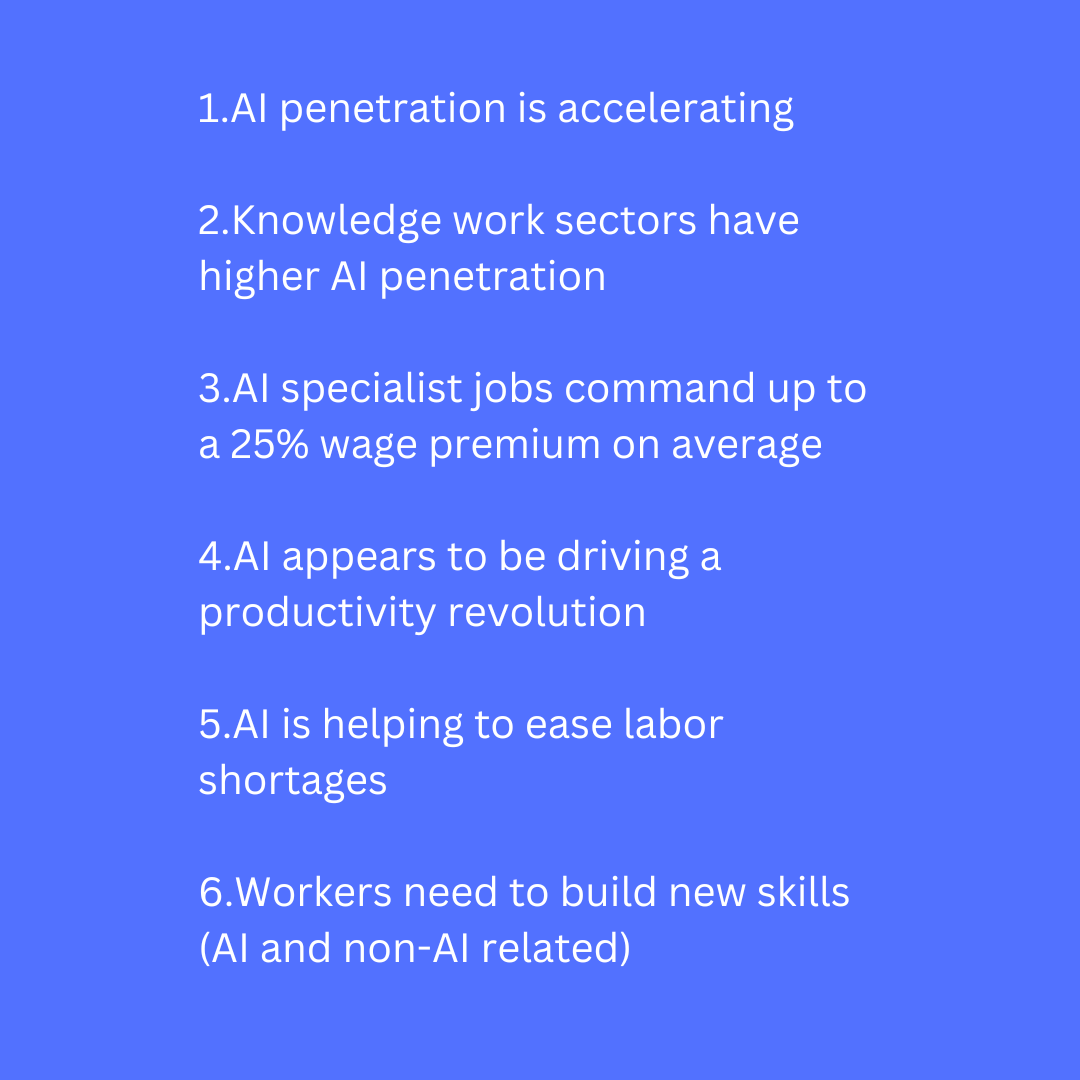
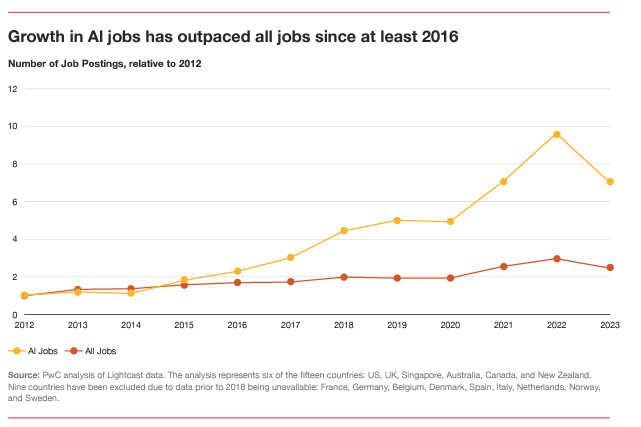
  1. AI penetration is accelerating. Growth in AI specialist jobs has outpaced growth in all jobs since 2016. Today, there are seven times as many postings for specialist AI jobs as there were in 2012. Openings for jobs that require specialist AI skills have grown 3.5 times faster than openings for all jobs since 2012.

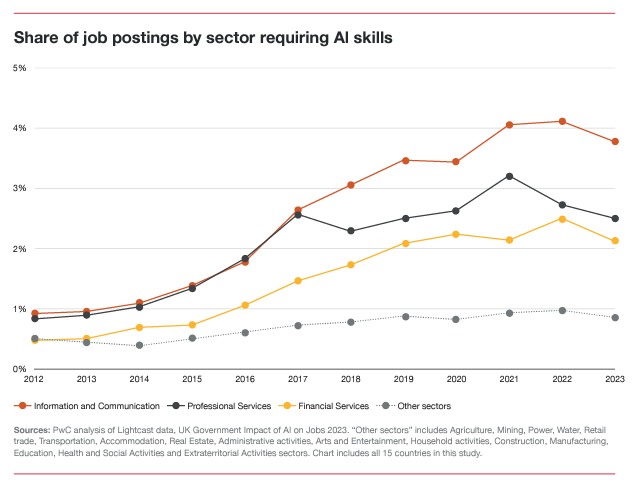
    2. Knowledge work sectors have higher AI penetration. The share of job ads requiring AI skills is higher in professional services, information & communication, and financial services. Financial services has a 2.8x higher share of jobs requiring AI skills vs other sectors, professional services is 3x higher, and information & communication is 5x higher.


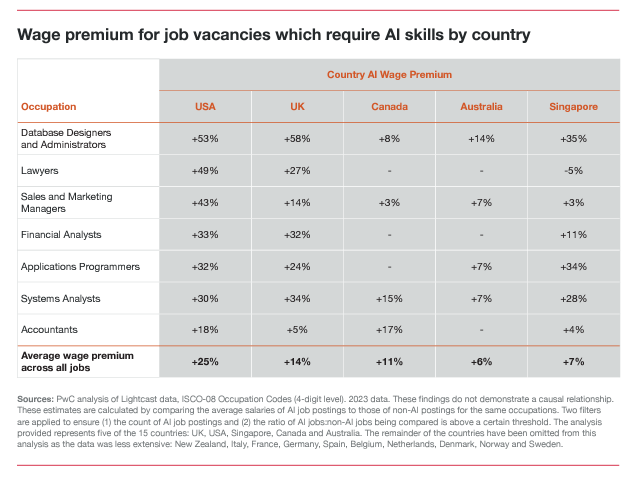
    3. AI specialist jobs command up to a 25% wage premium on average (In USA). AI’s value to companies is made clear by what is happening with the wages of workers with AI specialist skills. The wage premium varies by occupation when that occupation requires AI specialist skills.


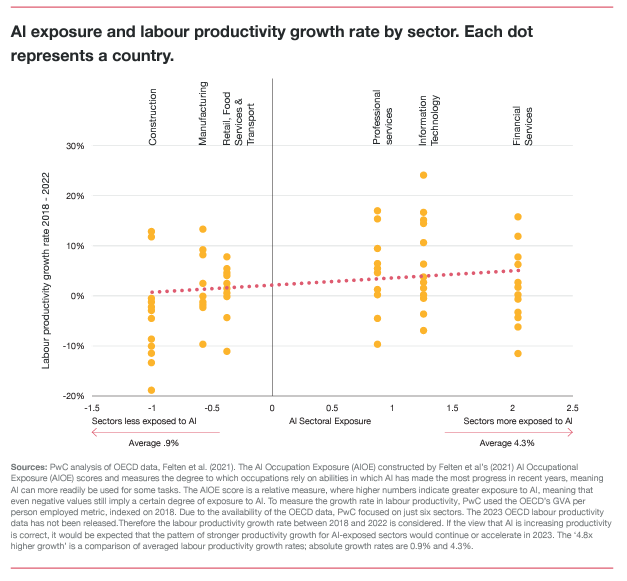
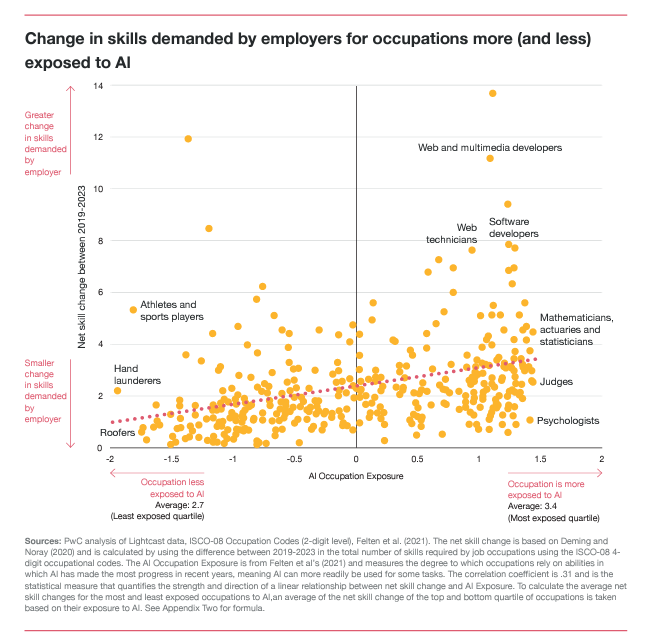
    4. AI appears to be driving a productivity revolution. To understand how AI is affecting all jobs, PwC examined jobs and sectors by their levels of ‘AI exposure’ which means the degree to which AI can be used for some tasks. Higher levels of AI exposure appear to be affecting workers’ productivity, numbers of job openings, and the skills that jobs require. The three sectors presented above with higher AI exposure: financial services, IT, and professional services – are seeing nearly 5x faster productivity growth than sectors with lower AI exposure (such as transport, manufacturing and construction). Even though correlation does not imply causation, this is an interesting insight.


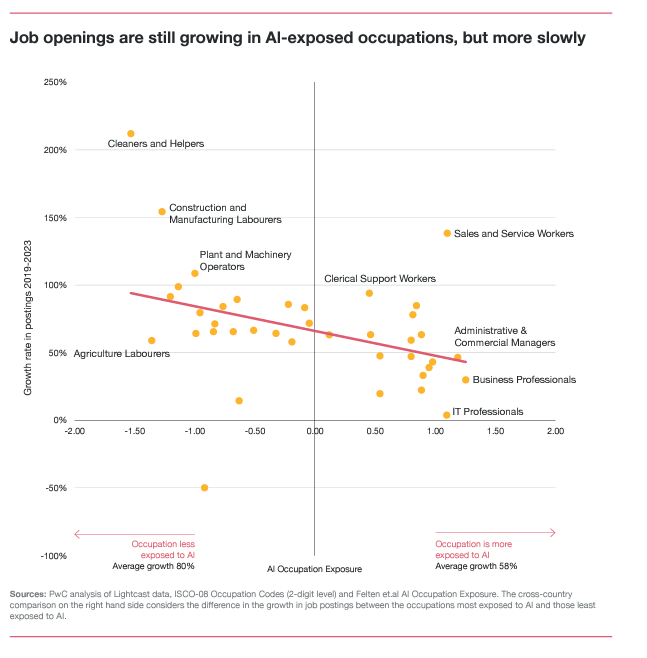
    5. AI is helping to ease labor shortages. In AI-exposed occupations such as customer services and IT – where labor shortages are common – jobs are still growing, but 27% more slowly on average. The data suggests that AI does not herald an era of job losses but rather more gradual jobs growth, helping to enable companies to find the workers they need.


    6. Workers need to build new skills. The skills required by employers in AI-exposed occupations are changing fast. Old skills are disappearing from job ads – and new skills are appearing – 25% faster than in roles less exposed to AI. Some of the skills rising fastest in demand are those which cannot easily be performed by AI. The AI transformation is clear to see in categories like Information Technology where demand for AI-related skills like ‘AI/Machine Learning Inference’ is flourishing, while demand for some skills that may be more readily replaced by AI (such as coding in Javascript) is falling.


    Perhaps the most interesting insight from this report is the conclusion that AI is redefining what it means to be a financial analyst, a software coder, a customer service agent (and many more roles), opening up whole new possibilities for workers to deliver impact. Workers who learn to harness AI are likely to have bright futures in which they can generate greater value and could consequently have greater bargaining power for wages – all within a context of rising societal prosperity.

    What to do next:

    Business Leaders:

    • Embrace, experiment, and create new uses of AI
    • Use AI to generate new ways to create value: reinvent business models or pioneer new product lines
    • View AI as a powerful tool best used with human oversight (human + AI collaboration)
    • Offer AI training to all employees
    • Hire on the basis of skills vs degrees

    Workers:

    • Embrace AI, experiment with it, and seek ways for AI to complement the work they do
    • Build skills: either skills in areas that are hard for AI to do, or skills that complement AI

    You can read the full report at pwc.com/aijobsbarometer

    Unknown's avatar

    This is the one AI skill everyone needs to have and understand

    The AI field is being revolutionized through Generative AI, and this will bring powerful new capabilities that can be turned into value for individuals, businesses, and society. It is a great time to work with AI. But it is also overwhelming, and challenging, and confusing for most people. If you are outside the AI world, you may be wondering, What really is AI? Is AI going to save the world? is AI going to destroy the world? And on top of that… what is Generative AI? There are so many AI fields, and subfields, and capabilities, and technologies, and algorithms, and frameworks that it is hard to know where to start to understand it. So start here… learn one thing: AI IS PROBABILISTIC!

    What does probabilistic mean? it means, any answer you get from an AI system is not a precise answer but a prediction with a certain degree of confidence.

    AI systems are not programmed like other deterministic technologies. In the world of technology outside of AI, you program a computer to make deterministic “precise” decisions: i.e.: If the user clicks on this button, then show them an image, if the account balance reaches $5, send the user an email, etc. AI systems, on the other hand, are “trained’ using data to either predict new data based on the input data (traditional AI) – i.e.: an inventory level prediction, a product you might like – , or to generate/create complex new data based on an input prompt (Generative AI) – i.e.: images, videos, code and text -. Training an AI model means you feed it existing data and then use mathematical models that align well with that data to predict future data. In other words, what is underneath these AI predictions is a collection of mathematical, probabilistic models. In essence, you have something similar to a weather forecast: There an x% of chance that tomorrow will rain. We all know how that goes right? maybe it will rain, maybe it won’t because a weather forecast is based on a mathematical probabilistic model. Mathematical probabilistic models are the foundation of any AI system. The problem is that unlike weather forecasts, AI systems are not telling us “there is an x% chance that what I am telling you is correct”. They just give us an answer, so the responsibility today is on us to understand this.

    So now that you know that AI systems are probabilistic, how do you use this information? you must understand that any output from an AI system sometimes will be wrong, no matter how great it looks or how confident it sounds in the case of Generative Text models, and need to determine when it is safe to use them based on the impact of an incorrect output. Here are some examples of how to use this one skill to interact with AI:

    • Business Leaders. If you are a business leader driving an AI strategy, or aiming to leverage AI to impact your business area, know that with any AI implementation, not only you need to look at how to leverage AI to increase revenue, or reduce costs, or create new business models or new customer experiences. You also need to think about the increased need for risk management. What will happen in the % of cases that AI provides an incorrect answer? will the impact be minor? or will it be a disaster and guardrails need to be implemented?, or will it be a disaster of such magnitude that you can’t let this system be used unless there is a human in the loop? will a sector of the population be impacted different and negatively vs other segments of the population by automated AI-driven decisions? Always remember: AI outputs are not “precise” with 100% certainty. They are probabilistic with precision that is not 100%

    • Developers. Developers now have access to one of the greatest playgrounds in the world, with availability of multiple technologies to integrate AI capabilities into their applications. With just a call to an API, you can leverage pretrained AI models and add innovation to your applications without requiring the deep mathematical expertise required to train AI models. But if you haven’t worked with AI before, you are used to working with deterministic technologies. You call an API, you get a response, and that response should be 100% precise. With AI APIs, you are getting a probabilistic output which means, depending on the inputs you give the model you will get different results. These results may be very close to the answer you need if this input is similar to the data used to train the model, or completely nuts if this new input is significantly – mathematically speaking – different from any data used to train the model. Understanding this is key, as depending on the application where these capabilities are being integrated, you need to be mindful of causing no harm if the response this API produces is biased, or completely wrong. And if you are comparing models from different vendors, know that just testing models with a set of inputs may give you completely different results once you change the input sets. So do multiple tests. Don’t make the decision to leverage a model through an API, testing with a single set of inputs.

    • Data Scientists. You have got this. Even when you are not training Machine Learning models, but leveraging pretrained AI models, you are used to working in a probabilistic space. You need to be ambassadors of this understanding and drive other business and technical people in your organization, and friends in your circles, to internalize how to make decisions and evaluate outputs of AI technologies

    • Everybody else. The latest developments in the AI space have put AI in the hands of everyone. And more and more you will be using systems, tools, apps that have increased AI power. Just remember that any technology you are interacting with will give you results that are not correct. It doesn’t mean the system does not work – it is actually working as it should: in a probabilistic manner. It means you, the human, need to assess and think about the impact of the technology you are using and determine how safe it is for you to use it. For example, a tool that serves you an ice cream it “thinks” you should try, if you don’t have any allergies maybe is safe for you to use. But if you have a peanut allergy, maybe it is not safe to use unless there are guardrails that allow you to provide that restriction.

    In summary, today the field of AI could not be more exciting or more full of potential for individuals, businesses and societies, but because AI systems don’t tell us their outputs are probabilistic, we need to always remember it. And not only remember it but assess the impact of any decisions being made by AI systems for us, or by us based on an AI system output. Keep in mind that these technologies are so sophisticated, that if we don’t remember they are just giving us a probabilistic prediction, it is very easy to think that they are in fact reasoning, and even acting like a “real” human.

    Unknown's avatar

    AI and Generative AI are taking the world by storm

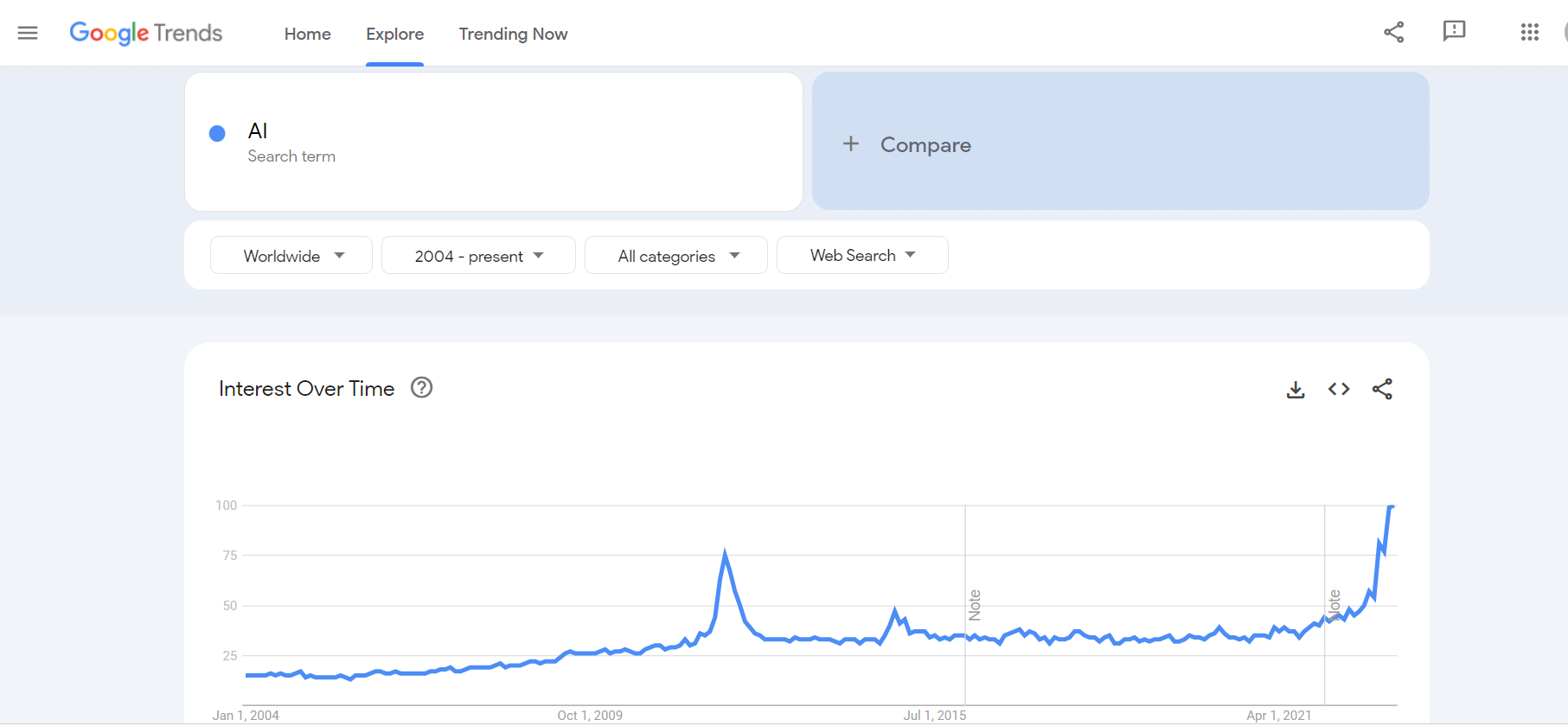
    AI is everywhere and the hype around it is like nothing we have ever seen before. Just take a look at what Google trends show us about worldwide web searches for the word AI during the past 19 years. There was a peak in 2011 probably generated by IBM Watson’s winning Jeopardy and Apple’s launch of Siri – 2 extremely significant innovations at the time. But nothing compares to the levels of interest generated over the past few months for AI and Generative AI.

    Worldwide Searches for the word AI – 2004-2023

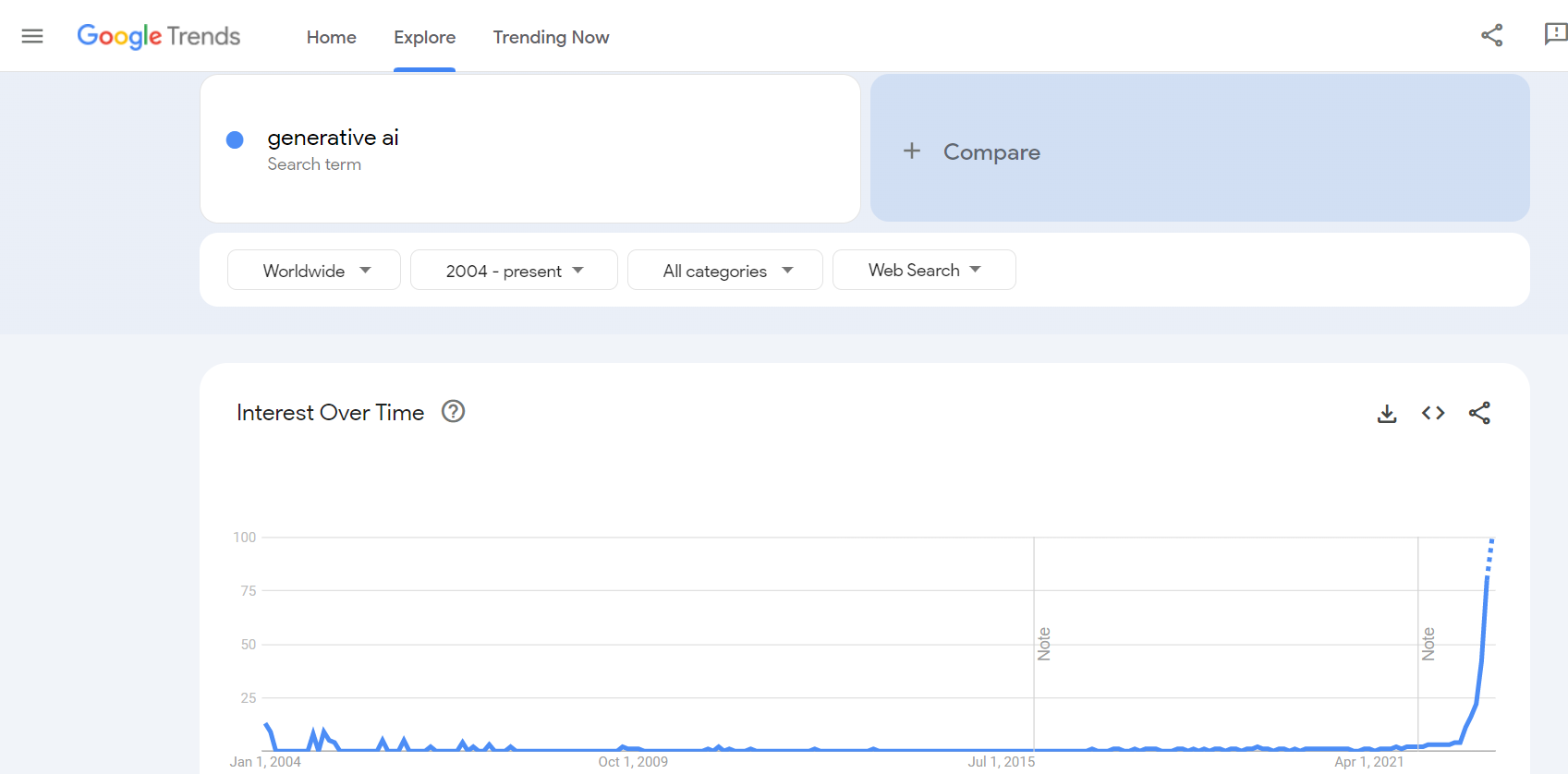
    I have worked in the AI field for over a decade, and I have never seen AI technologies evolve with such speed and innovation like we are seeing now through Generative AI. The AI field is being revolutionized, and these new technologies will bring powerful new capabilities that can be turned into value for individuals, businesses, and society. And this is what Google trends show us about worldwide web searches for Generative AI during the past 19 years.

    Worldwide Searches for the words Generative AI – 2004-2023

    This AI revolution is great for those of us that are passionate about AI’s capabilities to change the world in a positive way – as long as it is deployed with safety in mind. It is also highly relevant for businesses looking to derive incremental and transformational business value. It is safe to say that the world of AI is now moving into a whole new era.

    Unknown's avatar

    Data Analysts, Data Scientists, ML and AI Specialists are the jobs with highest demand according to WEF’s 2020 Future of Jobs report

    Summary

    In October 2020, The World Economic Forum published the report “The Future of Jobs”. This report has deep insights on technological adoption in the next five years, and it maps the jobs and skills of the future including a deep dive into Data and AI Skills. The report shows that technological adoption continues expanding, while skills availability remains the #1 barrier to that adoption. Businesses and governments around the world are investing significantly in upskilling and reskilling programs, with a significant percentage of that investment going towards transitions into Data and AI Jobs. Demand for Data Analysts, Data Scientists, and AI Specialists is high, but the skills gap that needs to be addressed to successfully transition into those roles is large.

    Some of the key findings:

    1. Skills gaps continue to be high. This includes skills like critical thinking, analysis, problem-solving, and skills in self-management such as active learning, resilience, stress tolerance and flexibility. On average, companies estimate that around 40% of workers will require reskilling of six months or less and 94% of business leaders report that they expect employees to pick up new skills on the job, a sharp uptake from 65% in 2018. 
    2. Online learning is on the rise. There has been a four-fold increase in the numbers of individuals seeking out opportunities for learning online through their own initiative, a five-fold increase in employer provision of online learning opportunities to their workers and a nine-fold enrollment increase for learners accessing online learning through government programs
    3. The window of opportunity to reskill and upskill workers has become shorter. The share of core skills that will change in the next five years is 40%, and 50% of all employees will need reskilling 
    4. The large majority of employers recognize the value of human capital investment. 66% of employers surveyed expect to get a return on investment in upskilling and reskilling within one year. Employers expect to offer reskilling and upskilling to over 70% of their employees, but employee engagement into those courses is lagging, with only 42% of employees taking up employer-supported reskilling and upskilling opportunities. 

    Over the past decade, a set of ground-breaking, emerging technologies have signaled the start of the Fourth Industrial Revolution. By 2025, the capabilities of machines and algorithms will be more broadly employed than in previous years, and the work hours performed by machines will match the time spent working by human beings. This augmentation of work will disrupt the employment prospects of workers across a broad range of industries and geographies, and we will see job growth in the ‘jobs of tomorrow’— such as roles at the forefront of the data and AI economy, as well as new roles in engineering, cloud computing and product development. 

    Technological Adoption

    The past two years have seen a clear acceleration in the adoption of new technologies. Cloud computing, big data and e-commerce remain high priorities, following a trend established in previous years. However, there has also been a significant rise in interest in encryption, and a significant increase in the number of firms expecting to adopt robots and artificial intelligence.  These new technologies are set to drive future growth across industries, as well as to increase the demand for new job roles and skill sets. Figure 1 shows technologies likely to be adopted by 2025 (by share of companies surveyed).

    By 2025 the average estimated time spent by humans and machines at work will be at parity based on today’s tasks. Algorithms and machines will be primarily focused on the tasks of information and data processing and retrieval, administrative tasks and some aspects of traditional manual labor. The tasks where humans are expected to retain their comparative advantage include managing, advising, decision-making, reasoning, communicating and interacting. 

    Emerging Jobs

    Similar to the last survey in 2018, the leading positions in growing demand are roles such as Data Analysts and Scientists, AI and Machine Learning Specialists, Robotics Engineers, Software and Application developers as well as Digital Transformation Specialists. However, job roles such as Process Automation Specialists, Information Security Analysts and Internet of Things Specialists are newly emerging among a cohort of roles which are seeing growing demand from employers. The emergence of these roles reflects the acceleration of automation as well as the resurgence of cybersecurity risks. Figure 2 shows the top 20 job roles in increasing demand across industries, with Data Analysts, Data Scientists, and AI Specialists ranked with the highest demand overall. 

    Figure 2 – Top 20 job roles in increasing demand across industries

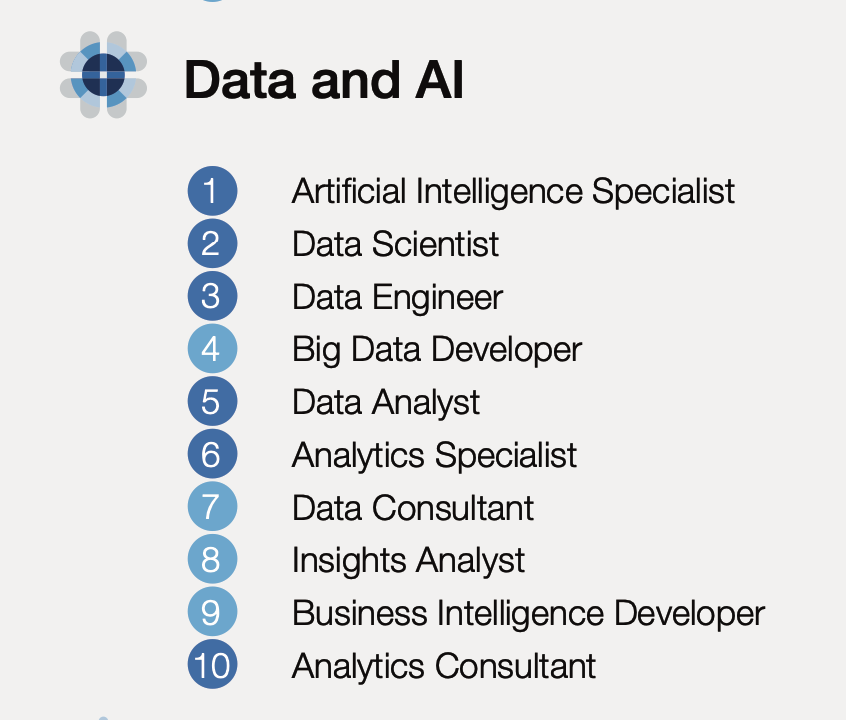
    These emerging jobs have been organized in clusters, and this report presents a unique analysis which examines key learnings gleaned from job transitions into those emerging clusters using LinkedIn and Coursera data gathered over the past five years.  The main clusters are: Data and AI, Cloud Computing, Engineering, Content Production, Marketing, People and Culture, and Product Development and Sales. Figure 3 shows Data and AI roles organized according to the scale of each opportunity within the cluster.

    Figure 3 – Data and AI Job Cluster

    Emerging Skills

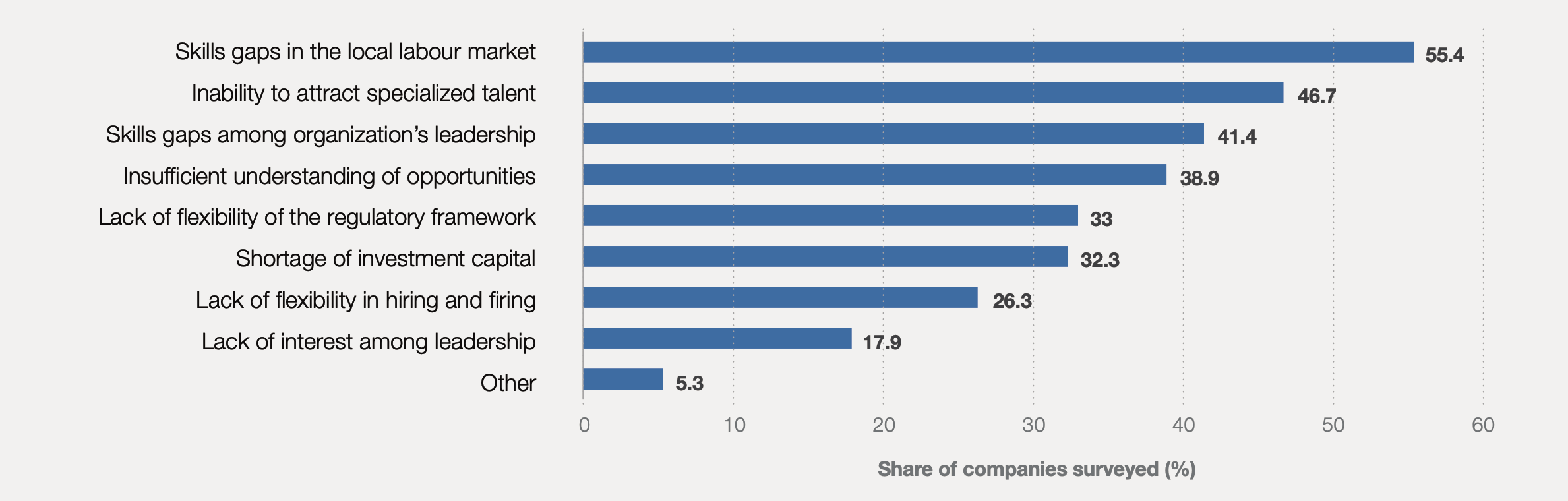
    The ability of global companies to harness the growth potential of new technological adoption is limited by skills shortages. Figure 4 shows that skills gaps in the local markets and inability to attract the right talent remain among the leading barriers to the adoption of new technologies. 

    Figure 4 -Perceived barriers to the adoption of new technologies

    Skill shortages are more acute in emerging professions. Business leaders consistently cite difficulties when hiring for Data Analysts and Scientists, AI and Machine Learning Specialists as well as Software and Application Developers. 

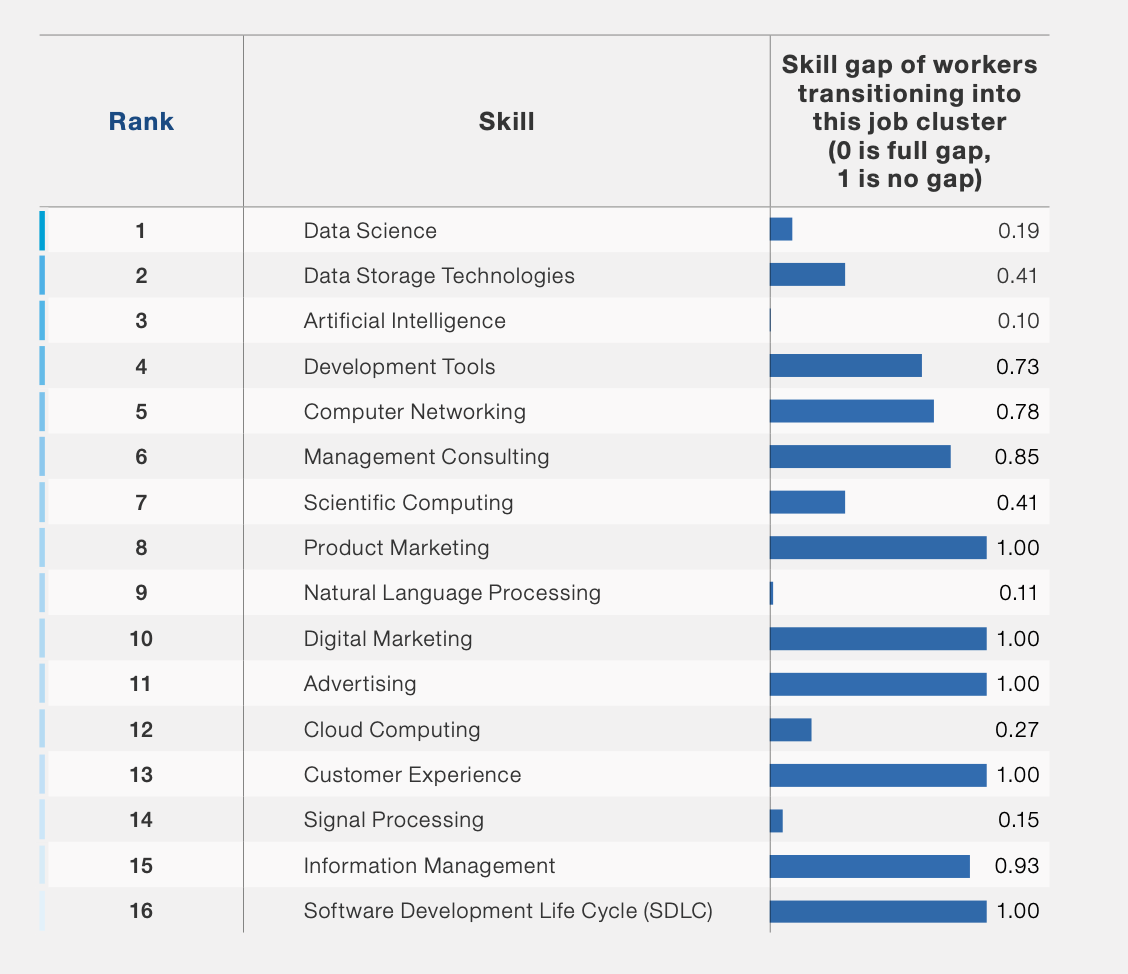
    To address skills shortages, companies are investing in upskilling and reskilling programs. However, employee engagement into those courses is lagging, with only 42% of employees taking up employer-supported reskilling and upskilling opportunities. There are however significant challenges in the amount of skills that need to be developed especially for emerging roles in Data Science and Artificial Intelligence.  Figure 5 illustrates the skills gap that needs to be closed for individuals to transition into these roles, with Artificial Intelligence, NLP, Data Science and Signal Processing representing the largest amount of skills needed to be developed for a successful transition.

    Figure 5 – Typical skills gaps across successful job transitions

    Furthermore, the report uses data from Coursera learners to estimate the distance from the optimal level of mastery for learners targeting to transition into Data and AI, and quantifies the days of learning needed for the average worker to gain that level of mastery. (Figure 6).

    Figure 6 – Top 10 skills by required level of mastery and time to achieve that mastery

    Mastery score is the score attained by those in the top 80% on an assessment for that skill. Mastery gap is measured as a percentage representing the score among those looking to transition to the occupation as a share of the score among those already in the occupation. 

    In conclusion, technological adoption continues expanding, and skills availability remains the #1 barrier to that adoption. Businesses and governments around the world are investing significantly in upskilling and reskilling programs, with a significant percentage of that investment going towards transitions into Data and AI Jobs. Demand for Data Analysts, Data Scientists, and AI Specialists is high, but the skills gap that needs to be addressed to successfully transition into those roles is large.

    Unknown's avatar

    What is Cognitive Computing? The 3 Things Series

    *** The 3 Things Series aims to simplify – sometimes even oversimplify – technology concepts so that you learn 3 things about a topic ***. Opinions are my own.

    Cognitive Computing is an evolving technology that –  although in its infancy – has the potential to revolutionize all industries, by redefining how work gets done, and by augmenting human capabilities.

    In a general sense, cognitive systems – with IBM Watson at the forefront of this new era – combine natural language processing, machine learning, and real-time computing power to process vast amounts of data – structured and unstructured – to provide answers to a specific request.

    These systems are very different from traditional systems that are programmed based on rules and logic. They enable people to create value finding insights in volumes of data, while mimicking cognitive elements of human expertise. They “learn” about a specific domain, develop hypothesis, evaluate those hypothesis, and choose the best option. They do this at massive speed and scale.

    So what does this all mean? I find that the best way is to show you the origins of IBM Watson. If you watch this 3-minute video, you will have a better understanding: http://bit.ly/2qhElVe

    So how does a cognitive system work?

    1.    The system first needs to be trained with domain specific data. If we think of jeopardy, Watson had access to about 200 million pages of structured and unstructured content including the full text of Wikipedia. This stage is very important as the outcomes will be as good as the information used in the training process. In fact, when Watson was being developed, the urban dictionary was included as part of the training only to be removed later when pretty quickly it learned how to use offensive words. If we think about the field of oncology for example, then the training data will include information on research papers, drugs used, demographics data on individuals receiving training, outcomes, etc.  So it must be able to understand both structured and unstructured data, but also to interact with humans in a natural way (through natural language)

    2.    Once a system is trained, it will have the ability to form hypothesis, make considered arguments and prioritize recommendations to help humans make better decisions.    Cognitive systems are probabilistic, and they generate responses according to levels of confidence. They can also show the evidence for the responses—what data there is to back up the answer and the confidence score. If we think about the jeopardy scenario, you probably noticed on the video above that the top 3 options together with their confidence score were displayed on the screen. Decisions can then be made based on those confidence scores to select the best option. In the oncology example, the ability by a doctor to look at all the evidence the system used, and at the collection of hypothesis that could potentially include some that the doctor had not considered before, is extremely valuable.

    3.    Cognitive systems ingest and accumulate data insights from every interaction. The confidence levels it provides are subject to change when subject matter experts grade the responses since the system is not programmed but trained by experts who enhance, scale and accelerate their expertise.

    So what are the 3 things to remember about cognitive systems? They are trained, not programmed, they provide probabilistic responses with confidence levels instead of exact answers, and can get better overtime as experts enhance, scale and accelerate their expertise.